Are You Growing Revenue or Just Workload?
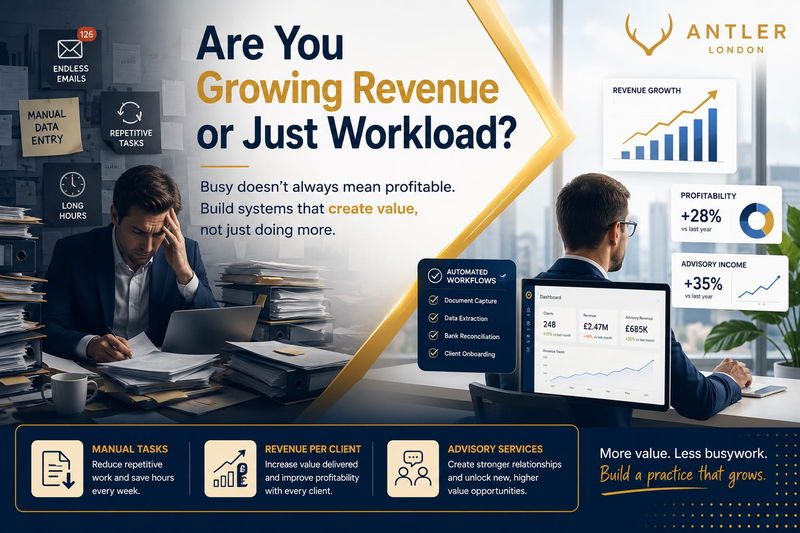

Running a successful accounting practice has never been easy. Between changing regulations, increasing client expectations, and the rapid pace of technology, many firm owners find themselves working longer hours than ever before. Yet despite the extra effort business growth often feels frustratingly slow.
This raises an important question: Are you genuinely growing your revenue or are you simply growing your workload?
For many UK accounting firms the answer isn't immediately obvious. A growing client list, busier staff, and packed calendars can create the illusion of progress. But if profits remain stagnant, advisory work never gets the attention it deserves, and the team spends most of its time completing repetitive compliance tasks, then the business may be expanding in volume rather than value.
Understanding the difference is becoming one of the most important strategic challenges facing modern accounting practices.
Why More Clients Don't Always Mean More Profit
Growth is often measured by the number of new clients a firm acquires each year. While attracting new business is important it doesn't automatically translate into healthier financial performance.
Many firms experience a familiar cycle:
More clients create more administrative work.
More administrative work requires additional staff.
Higher staffing costs reduce profit margins.
Partners spend more time managing operations instead of developing the business.
Eventually, the firm reaches a point where everyone is busier yet profitability barely improves.
This is workload growth not revenue growth.
True growth occurs when a practice increases the value it delivers without increasing operational complexity at the same pace.
The Hidden Cost of Manual Processes
Many accounting firms continue to rely on processes that were designed years ago even though client expectations have changed dramatically.
Manual document collection, repetitive data entry, email chains for approvals, fragmented communication, and disconnected software all consume valuable time. Individually these tasks may seem minor, but together they can absorb hundreds of hours every month.
Those hours represent lost opportunities.
Every hour spent on repetitive administration is an hour that cannot be invested in advisory conversations, business planning, client relationships, or strategic growth initiatives.
Modern technology is helping firms reduce these inefficiencies, but technology alone isn't the solution. Successful firms redesign their workflows before they automate them.
Revenue Growth Comes From Higher Value Services
Clients today expect more than tax returns and annual accounts. They increasingly look to their accountant for guidance on cash flow, forecasting, business performance, tax planning, and long term decision making.
These services create stronger client relationships while generating higher value revenue.
The challenge is that firms struggling with operational bottlenecks rarely have the capacity to deliver them consistently.
When teams are overwhelmed with routine work, advisory services become something they'll get around to rather than a core part of the business.
Reducing operational friction creates space for the work that clients value most.
Measure the Right Metrics
Many firms celebrate being busy, but being busy is not a business strategy.
Instead of measuring success purely by client numbers or hours worked consider tracking metrics such as:
Revenue per client
Revenue per employee
Advisory income as a percentage of total revenue
Client retention rates
Average response times
Time spent on manual administration
Capacity available for strategic client work
These indicators provide a clearer picture of whether the business is becoming more valuable or simply more demanding to run.
Technology Should Create Capacity, Not Chaos
Artificial intelligence and automation are changing the accounting profession but their greatest benefit isn't replacing accountants.
Their real value lies in removing repetitive work so professionals can focus on judgement, relationships, and strategic advice.
Document processing, transaction categorisation, workflow management, client onboarding, and routine communications can increasingly be streamlined through modern software.
However, firms should avoid adopting technology simply because it's new. Every investment should solve a specific business problem and support long-term objectives.
Technology is most effective when it helps create additional capacity rather than adding another disconnected system for employees to manage.
Think Like a Business Owner, Not Just an Accountant
One of the biggest shifts taking place across the profession is the transition from managing an accounting practice to building a scalable business.
That means asking different questions:
Can our current systems support twice as many clients?
Are we creating repeatable processes?
Which activities genuinely require human expertise?
Where does our firm create the most value?
How much partner time is spent on administrative work versus strategic leadership?
These questions move the conversation beyond compliance and towards sustainable business growth.
The Competitive Landscape Is Changing
The accounting profession is becoming increasingly competitive.
Digital first firms, AI powered platforms, cloud accounting ecosystems, and technology enabled service providers are changing client expectations. Businesses now expect faster communication, greater efficiency, and more proactive advice.
This doesn't mean traditional firms are becoming obsolete.
It means firms that continue relying on yesterday's operating model may struggle to compete with businesses that have redesigned how they deliver their services.
The firms achieving sustainable growth are often those that combine experienced professionals with modern systems that improve efficiency while strengthening client relationships.
A Broader Strategic Perspective
The question isn't whether accounting firms should adopt AI or modern technology. Most already are in some form.
The more important question is how those investments fit into a broader business strategy.
This is where many discussions stop too early.
Richard Plasek explores this challenge in Build, Buy, or Disappear. Rather than focusing solely on AI tools, the book examines how different types of accounting firms should approach long term strategic decisions. It introduces distinct pathways for independent practices and larger PE backed firms, explores how client relationships influence long term value, and explains why technology choices should always support broader business objectives not replace them.
Whether a firm chooses to buy existing AI solutions or invest in building proprietary capabilities, the underlying goal remains the same: create a business that generates greater value without simply increasing workload.
The Strategic Takeaway
Every accounting practice reaches a point where working harder is no longer enough.
Sustainable growth doesn't come from adding more tasks to already busy teams. It comes from improving the way work is delivered, increasing the value provided to clients, and creating systems that allow the business to grow efficiently.
So before celebrating another busy month ask yourself one simple question
Is your firm generating more revenue or just creating more work?
The answer may reveal far more about your firm's future than your latest client acquisition numbers ever could.

Comments
No comments yet. Be the first to comment!