What Shapes a Person? Exploring Trauma, Power, and Redemption Through The Smallest of Miracles
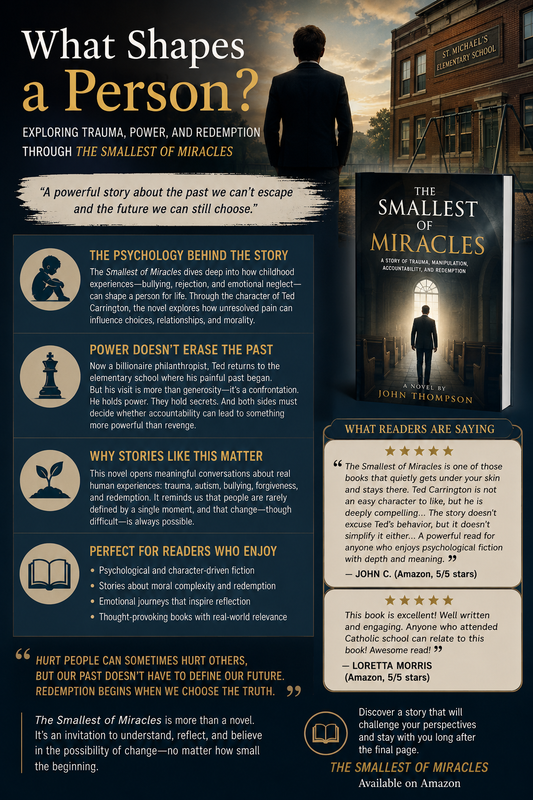

What transforms an innocent child into an adult capable of manipulating others? Can past trauma explain harmful behavior without excusing it? More importantly, is redemption possible for someone who has spent a lifetime hiding behind power?
These are some of the thought-provoking questions explored in The Smallest of Miracles, a psychological coming-of-age drama that goes far beyond traditional fiction. Rather than simply telling a compelling story, the novel invites readers to reflect on the lasting impact of childhood experiences, emotional neglect, bullying, and the complex relationship between accountability and forgiveness.
The Psychology Behind the Story
Modern psychology has consistently shown that childhood experiences play a significant role in shaping adult behavior. While every person's journey is unique, repeated bullying, social rejection, and emotional isolation can have profound effects on self-esteem, emotional regulation, and interpersonal relationships.
The protagonist, Ted Carrington, embodies this complexity.
As a child, Ted was an undiagnosed autistic boy who struggled to fit in. He experienced rejection and humiliation from peers while desperately searching for acceptance. Yet the novel refuses to portray him solely as a victim. Instead, it examines how unresolved pain can sometimes be redirected toward others, creating a cycle where those who suffer may also become capable of causing suffering.
This nuanced portrayal encourages readers to think beyond simple labels of "good" and "bad" and instead consider how human behavior often exists in morally uncomfortable gray areas.
Power Doesn't Erase the Past
By adulthood, Ted has become a billionaire philanthropist admired by society. To the outside world, he represents success, intelligence, and generosity.
But appearances can be deceiving.
When he returns to the struggling elementary school he once attended, his visit appears charitable. Behind the scenes, however, Ted possesses information that could destroy the careers of three school administrators.
Instead of seeking simple revenge, he offers them something unexpected: an opportunity to confront their own past decisions and choose a different future.
This central conflict raises important questions:
Can power truly heal old wounds?
Does success erase childhood trauma?
What happens when those who once held authority are forced to answer for their actions?
Can accountability become the first step toward redemption?
These questions resonate well beyond the pages of fiction.
Why Stories Like This Matter
Books that explore psychological development help readers understand both themselves and others. They encourage empathy without removing personal responsibility.
The Smallest of Miracles demonstrates that people are rarely defined by a single moment. Instead, lives are shaped by countless experiences, choices, failures, and opportunities to change.
For educators, parents, counselors, and anyone interested in human behavior, the novel provides meaningful discussion points about:
The long-term effects of bullying
Autism and social misunderstanding
Emotional neglect in childhood
Moral responsibility
Forgiveness versus accountability
Personal growth and redemption
These themes make the novel especially valuable for readers who enjoy character-driven psychological fiction with emotional depth.
What Readers Are Saying
Early readers have praised the novel for its emotional honesty and thoughtful exploration of complex human behavior.
One Amazon reviewer wrote:
"The Smallest of Miracles is one of those books that quietly gets under your skin and stays there. Ted Carrington is not an easy character to like, but he is deeply compelling... The story doesn't excuse Ted's behavior, but it doesn't simplify it either... A powerful read for anyone who enjoys psychological fiction with depth and meaning." — John C. (Amazon, 5/5 stars)
Another reviewer highlighted the book's engaging storytelling:
"This book is excellent! Well written and engaging. Anyone who attended Catholic school can relate to this book! Awesome read!" — Loretta Morris (Amazon, 5/5 stars)
A Story That Stays With You
Great psychological fiction doesn't simply entertain—it challenges readers to think differently about human nature.
The Smallest of Miracles explores the uncomfortable reality that hurt people can sometimes hurt others, while also reminding us that our past does not have to define our future. It is a story about trauma, manipulation, accountability, and the possibility of redemption when people choose to confront the truth instead of running from it.
For readers who appreciate emotionally rich, morally layered novels, The Smallest of Miracles offers a powerful journey that lingers long after the final page.

Comments
No comments yet. Be the first to comment!