How Misunderstood Children Learn to Mask Pain
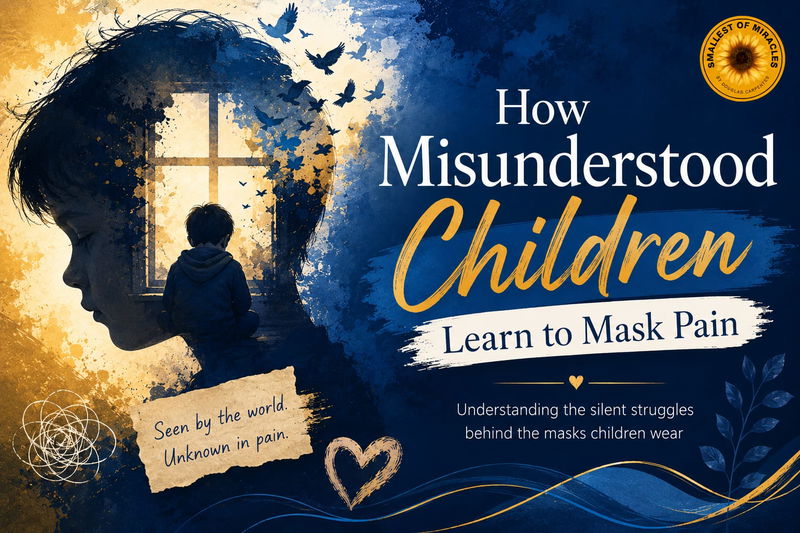

Every child wants to feel seen, accepted and understood. But when those basic emotional needs go unmet many children don't express their pain in obvious ways. Instead they become experts at hiding it.
Some learn to smile when they're hurting. Others become unusually quiet, overly obedient, or even aggressive. Behind these behaviors often lies a child who has learned that showing vulnerability feels unsafe.
Understanding why misunderstood children mask their pain is essential not only for parents and teachers but for anyone who wants to support healthy emotional development.
What Does It Mean to Mask Emotional Pain?
Masking is the process of hiding genuine emotions to avoid rejection, criticism or punishment. Children are especially vulnerable because they depend on the adults around them for validation and security.
A child who repeatedly feels ignored, bullied, misunderstood or compared to others may conclude that expressing sadness, fear or frustration only makes life harder. Over time they develop emotional masks designed to protect themselves.
These masks can appear in many forms:
Constant joking or pretending everything is fine.
Becoming a perfectionist to earn approval.
Acting tough to avoid appearing weak.
Remaining silent instead of asking for help.
Trying to please everyone while ignoring their own needs.
While these behaviors may seem harmless, they often conceal deep emotional struggles.
Why Some Children Feel Misunderstood
Children don't need perfect parents or perfect teachers. They simply need people who consistently make them feel heard.
Unfortunately, many children grow up believing something is wrong with them because their emotions are misunderstood.
Several experiences contribute to this feeling:
Bullying by peers.
Learning differences that go undiagnosed.
Autism or ADHD that isn't recognized.
Emotional neglect.
Constant criticism.
Unrealistic expectations.
Family conflict or instability.
When adults focus only on behavior instead of understanding the emotions behind it the children often stop trying to explain themselves altogether.
The Long Term Effects of Hiding Pain
Children who become skilled at masking emotions don't suddenly stop masking when they become adults.
Instead they often carry those survival strategies into every area of life.
They may struggle to:
Build authentic relationships.
Trust other people.
Ask for help.
Accept compliments.
Manage anxiety.
Regulate anger.
Recognize their own emotional needs.
Some become highly successful professionals while privately battling loneliness, shame or self doubt. Others become emotionally detached because vulnerability feels too dangerous.
In many cases, the world praises the mask without ever noticing the pain underneath it.
When Pain Turns Into Protection
Not every child who masks pain becomes withdrawn.
Some become controlling.
Some become manipulative.
Some seek power because power feels safer than vulnerability.
Psychologists often describe these behaviors as protective adaptations rather than personality traits. A child who once felt powerless may later develop an overwhelming need to control situations, relationships or even people.
That doesn't excuse harmful behavior but it helps explain where it often begins.
Understanding the roots of emotional pain allows us to address causes instead of merely reacting to consequences.
The Importance of Emotional Validation
One of the most powerful gifts an adult can offer a child is emotional validation.
Validation doesn't mean agreeing with every feeling or behavior. It simply means acknowledging that the child's emotional experience is real.
Simple responses like:
I can see you're upset.
That must have been difficult for you.
Tell me what happened.
can have a profound impact.
When children feel emotionally safe, they become less likely to hide their struggles behind masks.
Literature Helps Us Understand Hidden Pain
Some of the most memorable stories are those that explore the emotional lives people hide from the world.
Psychological fiction has a unique ability to reveal how childhood experiences shape adult identity, relationships and moral choices.
Douglas Carpenter's The Smallest of Miracles explores these themes through the life of Ted Carringtona billionaire philanthropist whose polished public image conceals a childhood marked by bullying, isolation, shame and an overwhelming desire to belong. As an undiagnosed autistic child who was both victim and perpetrator, Ted learns to protect himself by masking vulnerability behind intelligence, manipulation and control.
Rather than presenting simple heroes and villains, the novel examines how misunderstood children can develop complex coping mechanisms that influence every decision they make as adults. It asks difficult questions about redemption, accountability and whether people can truly rewrite the stories that shaped them.
For readers interested in psychological fiction, coming of age dramas and emotionally layered character studies The Smallest of Miracles offers a thought provoking exploration of the hidden wounds many people carry throughout life.
Helping Children Feel Truly Seen
Every misunderstood child carries a story that others cannot see.
Behind difficult behavior may be fear.
Behind silence may be heartbreak.
Behind perfectionism may be anxiety.
Behind confidence may be loneliness.
The goal isn't to eliminate every painful experience from childhood that isn't possible. Instead it's to create environments where children know their emotions matter and where asking for help is viewed as strength rather than weakness.
The children who feel understood today are often the adults who develop resilience without needing to hide who they truly are.
When we choose empathy over judgment and curiosity over assumptions, we give children something incredibly valuable like permission to stop wearing emotional masks and begin healing instead.

Comments
No comments yet. Be the first to comment!